
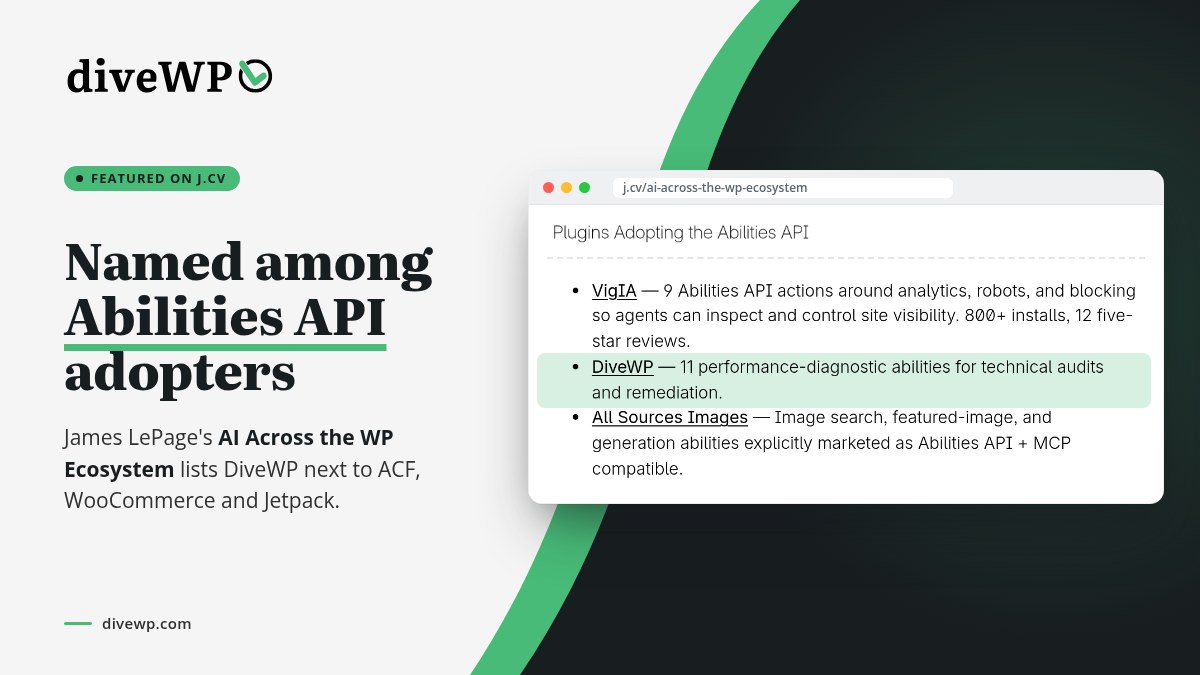
On 9 April 2026, James LePage published AI Across the WP Ecosystem on his site J.CV, a catalogue of community projects built on the new WordPress AI building blocks. DiveWP is in it. He listed my plugin under Plugins Adopting the Abilities API, next to ACF, WooCommerce, Jetpack, Ninja Forms, MainWP and others. This is the story behind that line, and what it means for anyone curious about the WordPress Abilities API.
At a glance
- Featured by James LePage on J.CV, 9 April 2026
- Section: Plugins Adopting the Abilities API
- Listed next to ACF, WooCommerce, Jetpack and MainWP
- DiveWP 3.0 now has 14 abilities, up from 11
In this post
What James LePage wrote about DiveWP
AI Across the WP Ecosystem catalogues what the WordPress community has built on the Core AI building blocks: the Abilities API, the WP AI Client, the MCP Adapter, and the AI plugin with the Connectors API. Provider plugins, MCP servers, agent skills, tutorials and hosting integrations are all in there. In the section Plugins Adopting the Abilities API, he picks out the notable plugins. DiveWP is one of them, and here is the line, word for word:
DiveWP — 11 performance-diagnostic abilities for technical audits and remediation.
James LePage, AI Across the WP Ecosystem, J.CV
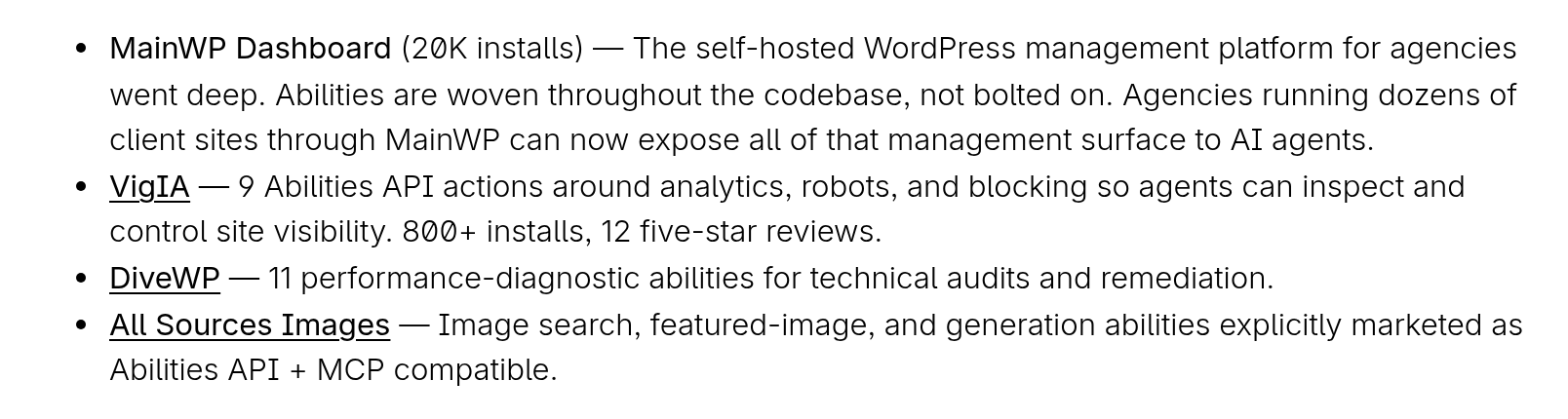
The DiveWP entry in the Plugins Adopting the Abilities API list on j.cv, between VigIA and All Sources Images.
The full list has 14 plugins: ACF 6.8, Ninja Forms 3.14.0, WS Form, WooCommerce, miniOrange, Jetpack, MainWP Dashboard, VigIA, DiveWP, All Sources Images, Virtual Media Folders, WP Password Policy, Fluid Design System for Elementor and Rapls AI Chatbot. Seeing DiveWP in the same list as ACF, WooCommerce and Jetpack is a real honour for me.
His main point is that this adoption came from the community, not from the top. In his words: “We built the building blocks. The community decided they were worth using.” You can read the full article on J.CV.
Who is James LePage?
James LePage, then Head of AI at Automattic and co-lead of the WordPress Core AI team, wrote the article as he prepared for his WordCamp Asia 2026 opening keynote. His team built the very building blocks the article is about.
Before that, he founded WPAI, a startup building AI solutions for WordPress, which Automattic acquired in December 2024. In May 2025 he founded the WordPress Core AI team and co-led it with Felix Arntz. During that year, the team shipped the Abilities API in WordPress 6.9, the WP AI Client in WordPress 7.0, the MCP Adapter and the AI plugin. His WordPress.org profile lists him as a core contributor to the WordPress 6.9, 7.0 and 7.1 releases.
His keynote, “WordPress and AI”, opened WordCamp Asia 2026 on 10 April 2026. In May 2026 he stepped back from leading Core AI and left Automattic, co-founded Parisi Labs, and stays involved with Core AI as an advisor.
What is the WordPress Abilities API?
The WordPress Abilities API arrived in WordPress 6.9. The Make WordPress Core AI team describes it as “a core WordPress API (introduced in 6.9) that creates a central registry of capabilities, making WordPress functions discoverable and accessible to AI agents, automation tools, and developers.”
In plain words: a plugin registers what it can do as abilities, and AI tools can find and use them in a standard way, instead of every plugin inventing its own integration.
Abilities API
A central registry where plugins describe what they can do. Available in WordPress 6.9 and later.
MCP Adapter
Makes registered abilities available to AI clients through the Model Context Protocol (MCP).
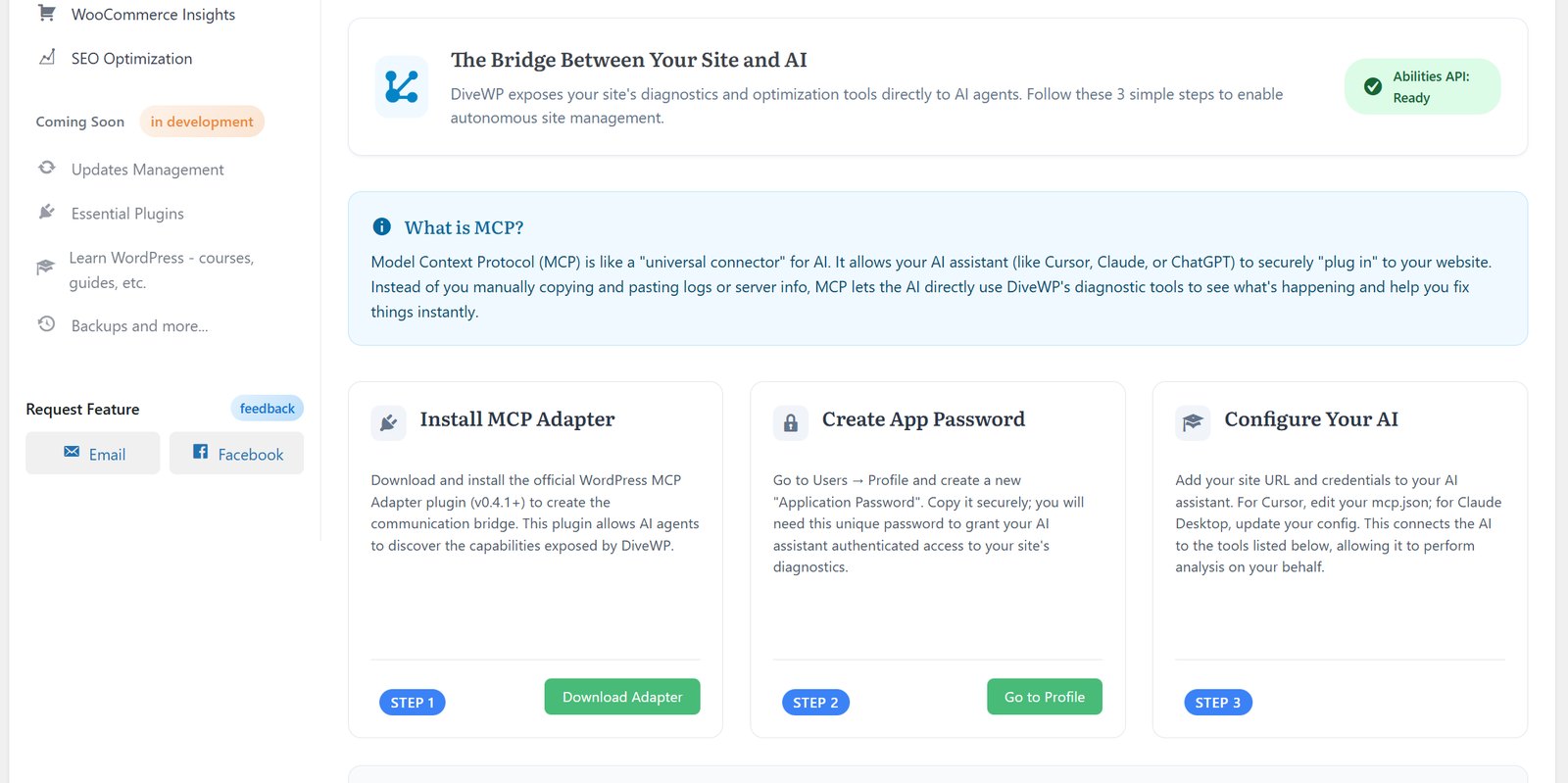
The DiveWP Abilities API and MCP setup screen walks you through the MCP Adapter, Application Passwords and your AI client.
From WordCamp Sofia to the Abilities API: the DiveWP timeline
DiveWP did not start as an AI plugin. It started as a site health toolkit that explains performance, security and database checks in plain English. Here is how it got from an idea to an Abilities API plugin.
1
August 2024. I finalised the concept of DiveWP and started active development.
2
WordCamp Sofia 2024. I announced DiveWP publicly for the first time.
3
January and February 2025. I shared the DiveWP 2 beta from divewp.com, and beta testers helped me fix the first bugs in version 2.0.1.
4
22 April 2025. DiveWP 1.0.0 went live on the WordPress.org plugin directory.
5
November 2025. Version 2.0.2 added the Hosting Benchmark, with database, server resource, concurrency and WooCommerce-style tests.
6
28 January 2026. Version 2.2.0 brought my first Abilities API and MCP integration, with 10 diagnostic abilities for AI agents.
7
February 2026. Plugins Management arrived in the 2.3 releases and became the 11th ability.
8
9 April 2026. James LePage listed DiveWP in AI Across the WP Ecosystem with 11 performance-diagnostic abilities.
9
21 May 2026. Version 2.4.0 added System Logs, WordPress 7.0 support and a 12th ability.
10
5 October 2026. DiveWP 3.0 shipped the AI Agent and 14 abilities, tested with WordPress 7.1.
In my interview with divna.Tech in April 2025, I said my next idea was to integrate an AI assistant into DiveWP. Version 3.0 is that idea, shipped.
From 11 to 14 abilities in DiveWP 3
When James wrote his article, DiveWP registered 11 abilities. Version 2.4.0 added System Logs, and DiveWP 3.0 brought the total to 14. Together they cover:
- Server
- Performance
- Database
- Security
- Theme and page builder
- WooCommerce
- SEO
- Email
- Hosting benchmark
- Cron
- Plugins
- System logs
- User Events
- AI Agent reports
On top of the abilities, DiveWP 3.0 adds the DiveWP AI Agent, an opt-in chat in wp-admin that answers site-health questions from DiveWP's own diagnostics. Abilities API integrations need WordPress 6.9 or later. The AI Agent needs WordPress 7.0 or later, the WordPress AI Client and a provider in Settings > Connectors. Standard diagnostics do not use an AI provider.
200+
active installs
5.0
stars from 6 ratings
9
releases on WordPress.org
Numbers from the DiveWP page on WordPress.org, 9 October 2026.
Free on WordPress.org. Setup help is in the DiveWP documentation.
Thank you, James, and thank you to the community
Being named by the person who co-led the Core AI team tells me DiveWP is on the right track with the Abilities API. Thank you, James, for including DiveWP in your catalogue.
And thank you to everyone who tested the betas, left a review on WordPress.org or reported a bug. DiveWP is a small plugin from Sofia, and each of those steps shaped it. If you are new here, start on the DiveWP homepage or open the documentation to set up DiveWP on your site.
WordPress Abilities API FAQ
What is the WordPress Abilities API?
It is a core WordPress API, introduced in WordPress 6.9, that creates a central registry of capabilities. Plugins register abilities there, so AI agents, automation tools and developers can discover and use them.
Which plugins use the WordPress Abilities API?
AI Across the WP Ecosystem names many of them, including ACF, WooCommerce, Jetpack, Ninja Forms, WS Form, MainWP Dashboard and DiveWP.
How many abilities does DiveWP register?
DiveWP 3.0 registers 14 abilities. The article mentions 11, which was the count when it was published in April 2026.
Do I need an AI provider to use DiveWP?
No. Standard diagnostics do not use an AI provider and work on WordPress 6.0 or later. Abilities API integrations need WordPress 6.9 or later, and the AI Agent needs WordPress 7.0 or later with a compatible provider.
Is DiveWP free?
Yes. DiveWP is free on the WordPress.org plugin directory.
Questions or ideas? Tell me on the DiveWP support forum or the contact page.